Ma Rainey's Black Bottom
Ma Rainey's Black BottomMa Rainey's Black Bottom is a song at the center of a dispute over musical authorship, performance, and control. During the Chicago recording session, Ma Rainey rejects Levee Green’s arrangement and insists on singing the song her way, while the recording company’s representative Irvin argues for an updated sound designed to excite listeners. The song’s journey from a contested rehearsal to Ma Rainey’s performance makes it a concrete test of whether a Black artist’s music will follow her own understanding or be reshaped to meet other people’s expectations.
Identity and Place in the Play
The song appears in the list of material prepared for the musicians alongside Prove It on Me, Hear Me Talking to You, and Moonshine Blues. Its presence on the list does not settle the matter of what will be performed: Cutler notices that the listed songs are not the ones Ma Rainey told him, while Slow Drag expects Ma Rainey to straighten the discrepancy out. From its introduction, then, the title belongs not only to the repertoire but also to a negotiation about whose instructions govern the session.
The action takes place in Chicago in 1927, in a play that frames its concern around Black city life and the Blues. Its opening account describes people on the Chicago South Side moving between cold-water flats and rented rooms and the bars and juke joints where music accompanies their lives. The song is one particular piece within this wider musical world. The play distinguishes the music’s importance from the mere fact of its being recorded: Blues connects people and expresses a way of being shaped by experience.
Rehearsal and Dispute Over the Arrangement
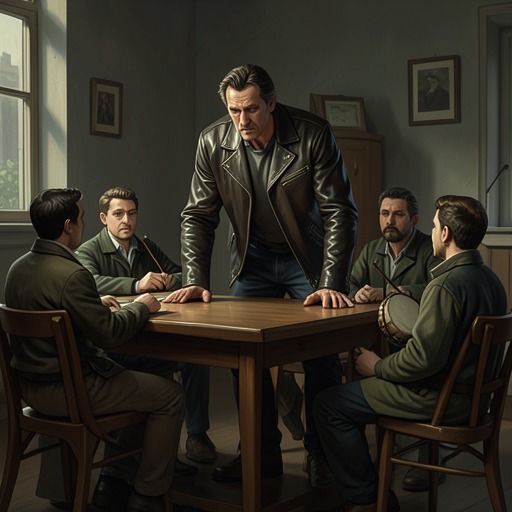
When the musicians begin rehearsing the song, Levee Green plays something different from the expected version and stops the attempt, objecting to the way they are playing it. The interruption makes the arrangement an immediate point of conflict rather than an invisible technical choice. What might sound like a disagreement about how to begin the number quickly becomes a question of who has the right to define it.
Ma Rainey hears the band rehearsing and asks whether they are playing Levee Green’s version. Irvin answers that the arrangement has a horn introduction and a quality that lifts the song. He argues that listeners now want music they can dance to, and that Levee Green’s treatment can excite them and help them forget their troubles. His defense casts the new arrangement as commercially responsive: its value lies in what it can do for an audience.
Ma Rainey refuses that reasoning. She says she dislikes what Levee Green has done to the song and intends to use the old way. She will not let him alter her song, and she contrasts singing her own song with singing Levee Green’s version. Her refusal is not simply a preference for one musical detail over another; it asserts her authority over the performance. She also directs that her nephew, Sylvester Brown, be brought down to meet the band because she promised her sister to look after him and wants him to give the spoken introduction to the song her way. The decision ties the musical dispute to family responsibility as well as artistic control.
Performance and the Meaning of the Blues
The song reaches performance with Sylvester Brown’s spoken introduction, which presents Ma Rainey as about to show her Black Bottom. Ma Rainey then sings the opening, which locates a friend called Dancing Sammy down in Alabama. The scene places a spoken lead-in beside the sung number: Sylvester Brown’s contribution introduces the performance, but Ma Rainey’s voice and chosen version remain its center.
Elsewhere, Ma Rainey explains why music matters beyond entertainment. Silence is something she cannot stand; music in her head keeps things balanced and makes the world feel fuller. She says that the Blues express life and help people understand it, rather than serving simply to make a singer feel better. A song can help someone get out of bed knowing they are not alone, because it has added something to the world. These reflections give the title song a context in which performance is a form of connection and recognition, not merely a product shaped for dancing.
Toledo calls Ma Rainey the Mother of the Blues because she fills an emptiness in a way people have come to need. Ma Rainey, however, does not claim to have invented the Blues; she says that it has always existed. That exchange places her authority in a tradition larger than any one performer. Her insistence on singing the song her way therefore sits alongside her recognition that the music precedes her and exceeds her.
Race, Commerce, and Musical Authority
The contrast between Ma Rainey’s insistence and Irvin’s sales-minded argument unfolds within the play’s broader account of racial power. In a discussion of the Blues, Toledo describes Black people as historical leftovers: the past remains present even after those who made it have moved on to another history. Cutler’s account of Reverend Gates, whose Bible and cross are taken and who is forced to dance for white men, gives that argument a brutal human instance. Cutler connects the story to Ma Rainey’s position, warning that white people can treat her as someone from whom they can make money rather than as a person whose identity and music they understand.
Against this backdrop, Irvin’s appeal to what listeners want is not a neutral artistic standard. It favors an arrangement meant to make the audience dance, while Ma Rainey defends her right to determine how her own song is sung. The play does not reduce the Blues to a choice between tradition and innovation: Levee Green’s new arrangement represents a competing musical possibility, while Ma Rainey’s refusal establishes who will decide the form of this performance. The song becomes the point where artistic change, commercial expectation, and a Black performer’s authority meet, and where Ma Rainey makes clear that an arrangement’s market appeal does not give another person ownership of her song.